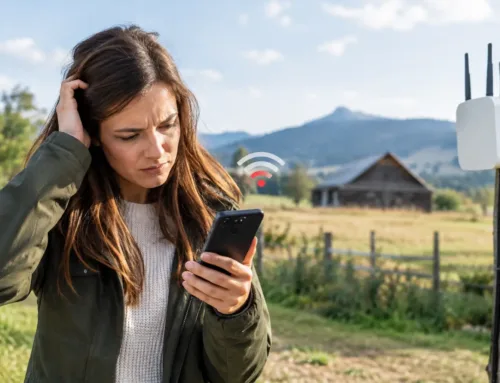
A farm office can have a usable fixed line while a lambing shed half a mile away has no signal at all. A rural home may have clear skies but sit in a hollow where mobile coverage is weak. These are the practical details that decide Starlink versus 5G broadband, not the headline speed printed on a leaflet.
Both services can transform a poorly served property. Both can support cloud systems, cameras, Wi-Fi calling and day-to-day business use where conventional broadband is inadequate. But they reach your site in very different ways, and the best choice depends on the landscape, the available mobile network and what must stay connected.
Starlink versus 5G broadband: the fundamental difference
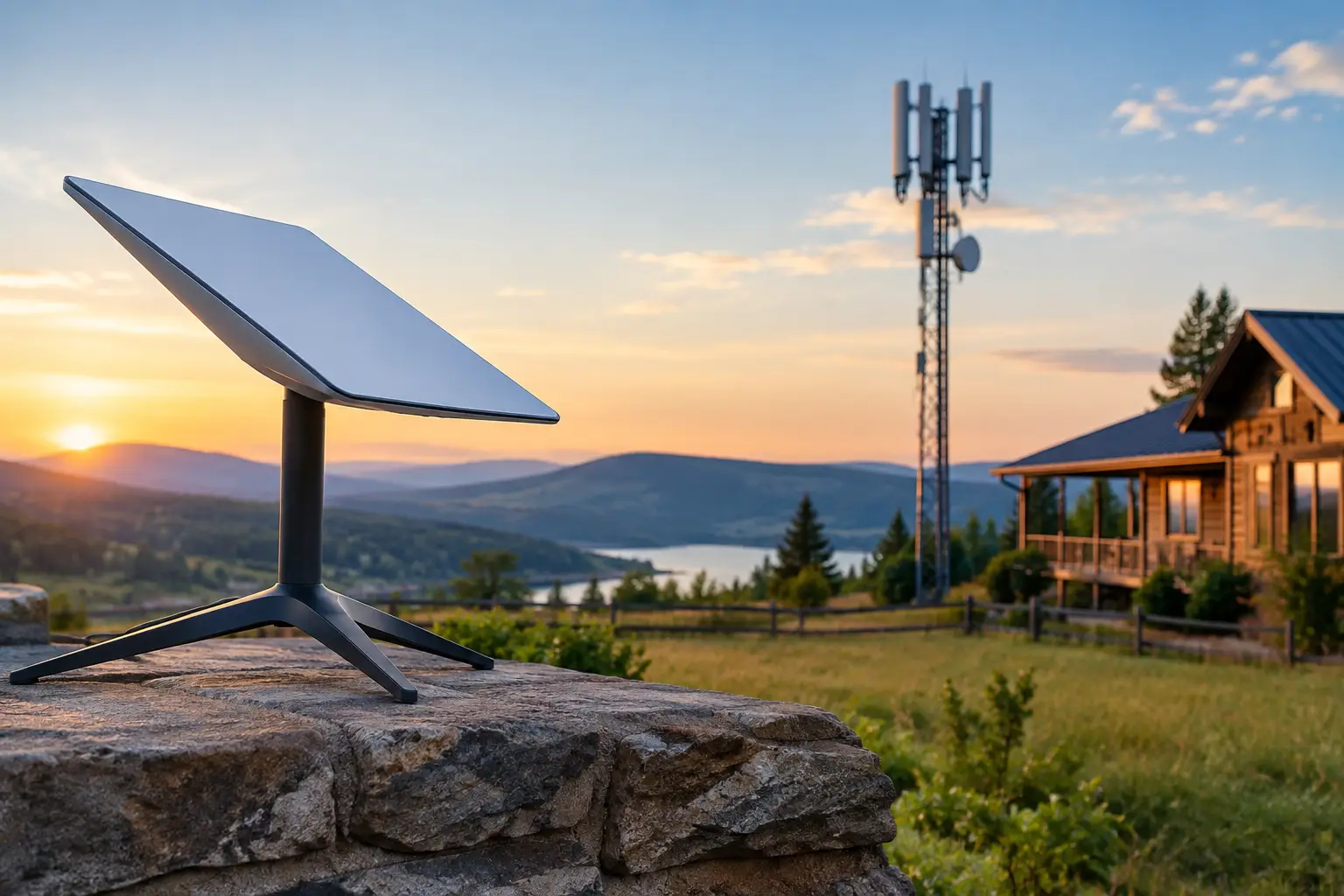
Starlink receives its connection from low-Earth-orbit satellites. A dish installed at your property communicates directly with the satellite network, then feeds internet into a router and your local network. It does not rely on a nearby mobile mast or a telephone line reaching the building.
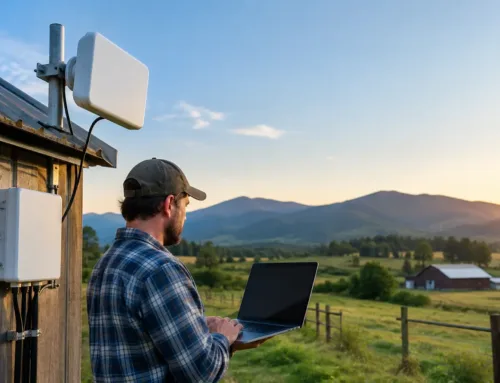
5G broadband uses the mobile network. A 5G router and external antenna connect to a local 5G mast, then distribute internet by Ethernet or Wi-Fi. In the right location, this can deliver excellent performance with relatively straightforward equipment. Its success, however, is tied to the quality and capacity of the mobile signal at that exact point on your site.
That distinction matters on large farms and estates. A 5G installation may work exceptionally well on a roof with a clear view towards a mast, yet perform poorly on the far side of a hill or inside a steel-clad building. Starlink is less affected by local mobile coverage, but it needs a broad, unobstructed view of the sky. Mature trees, nearby roofs, woodland edges and certain yard layouts can interrupt that view.
When 5G broadband is the stronger option
Where a reliable 5G signal is available, 5G broadband is often an excellent rural solution. It can provide high download speeds, responsive performance and enough capacity for a home, office or smaller business. It is particularly attractive where a suitable antenna position has a clear line of sight to the serving mast.
For a farmhouse, rural office or holiday let, 5G can be a cost-effective alternative to a slow copper line. It can also be used as the primary connection at a business unit where fibre has not yet arrived. Upload performance can be good too, which matters for sending camera footage to the cloud, backing up office files and making video calls.
The important word is reliable. A coverage map is useful as an initial indication, but it is not a site survey. Mobile performance can change significantly between a roadside, a first-floor window, a roof ridge and an outbuilding. Building materials, terrain, foliage and the direction of the mast all affect the result.
Network congestion should also be considered. A 5G connection can test very quickly at one time of day and slow down when the local mast is busy. For general browsing this may be acceptable. For a site relying on remote CCTV monitoring, card payments, cloud software or regular video meetings, the connection needs to be assessed over realistic working conditions.
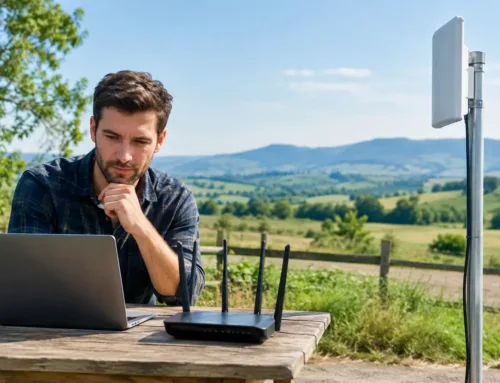
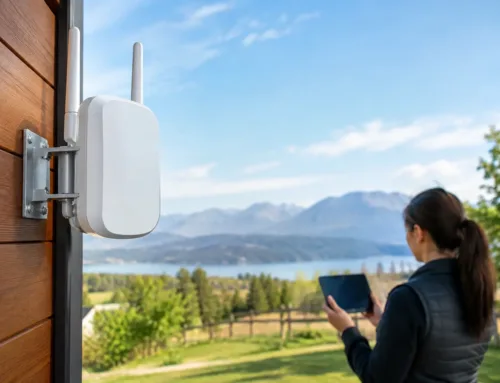
An external directional antenna is often the difference between a marginal 5G service and a dependable one. It can be mounted where the signal is strongest, with the router placed indoors and connected by proper network cabling. This is more purposeful than leaving a consumer router on a windowsill and hoping for the best.
Where Starlink makes most sense
Starlink comes into its own where mobile coverage is poor, inconsistent or absent. For isolated homes, agricultural buildings, temporary compounds and remote work areas, it can provide broadband without waiting for a new fixed-line network or being within range of a suitable 5G mast.
It is well suited to locations such as a remote cattle shed, an estate workshop, a construction or restoration project, and an event site needing temporary connectivity. It can also provide a practical primary connection for properties that have been left behind by fibre roll-outs.
The performance is generally capable of supporting multiple users, cloud applications, streaming, video calls and connected security systems. Latency is higher than a good fibre connection but is usually suitable for normal business communications and remote access. For most rural users moving from very slow ADSL or unstable mobile data, the improvement can be substantial.
Starlink is not entirely free from environmental considerations. The dish needs a clear view, so a proposed mounting point should be checked properly before installation. Obstructions can cause brief interruptions, which may be noticeable during a live call or when a critical device has no backup route. Power also matters: if the site loses electricity, the internet service will stop unless the router and dish are supported by an appropriate battery backup or generator arrangement.
For some temporary requirements, renting Starlink equipment can make more sense than buying it. This can suit seasonal operations, rural events, short-term site offices or a property awaiting permanent fibre installation.
Speed matters, but it is not the whole decision
It is tempting to choose based on whichever option advertises the highest download figure. On a working rural site, consistency is usually more valuable. A connection that delivers steady service to the office, CCTV recorder and staff Wi-Fi is often preferable to a faster connection that drops out or slows sharply at busy times.
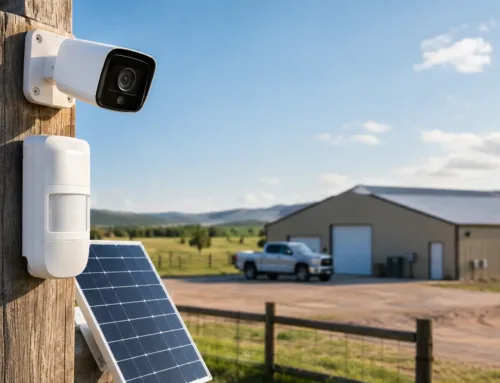
Upload capacity deserves particular attention. Security systems may need to send live video to a phone, push alarm notifications, or allow an installer to carry out remote diagnostics. A handful of high-resolution cameras can create significant traffic, especially if they are configured to upload continuously rather than send event-based footage.
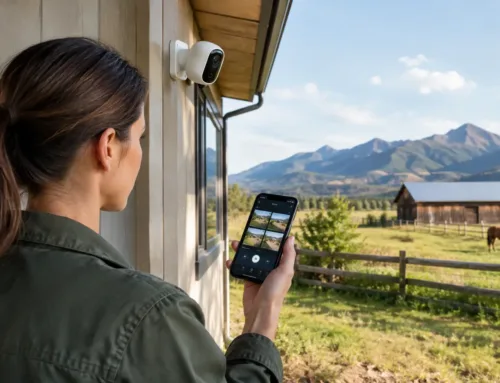
The same is true for livestock-monitoring cameras. A calving, lambing or foaling camera is only useful when the person responsible can view it from the house, yard or off site. Good connectivity supports that visibility, but the camera system, local Wi-Fi and network design must be planned as one system. Broadband alone cannot compensate for weak wireless coverage at the shed.
A wired network still has a place
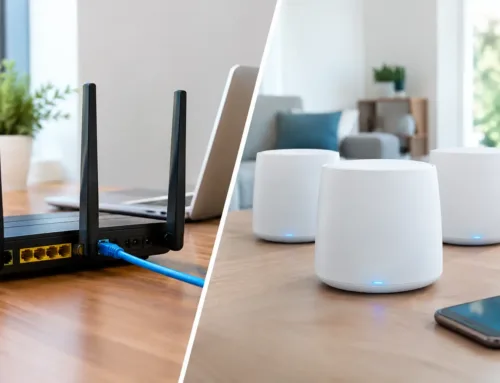
Once internet reaches the property, the next challenge is distributing it. Large homes, stone buildings, farmyards and long runs between buildings are rarely served well by a single Wi-Fi router. Professional design may use external wireless links, fibre or copper cabling, managed Wi-Fi access points and separate network connections for business devices, visitors and security equipment.
This is particularly relevant if the broadband connection serves CCTV, intruder alarms, office systems and domestic use together. Separating critical equipment from general Wi-Fi traffic helps maintain performance and makes faults easier to identify.
Choosing for farms, estates and businesses
A useful starting point is to consider what is available before deciding what is preferable. If a survey confirms a strong, stable 5G service at the required building, 5G may be the most efficient answer. If there is no dependable mobile signal, or the mast is obscured by terrain, Starlink may remove the biggest barrier immediately.
There are also occasions where using both is sensible. A primary 5G connection with Starlink as a backup, or the reverse arrangement, can provide added resilience for sites where lost connectivity has real consequences. This may apply to an office with remote workers, a business with cloud-based tills, or a security-heavy property where cameras and alarms need an independent route to the outside world.
For sites with several buildings, do not assume every building needs its own broadband contract. A main connection can often be extended across the site using point-to-point wireless links or underground cabling. This approach can bring dependable connectivity to workshops, holiday accommodation, gatehouses and livestock sheds while keeping the system easier to manage.
Start with the site, not the product
The right answer is rarely found by choosing a package online without looking at the property. A proper assessment considers mobile signal readings, likely mast direction, sky visibility, power availability, cable routes, building construction and where internet is needed most. It should also account for future plans, such as adding cameras, creating office space or extending coverage to another building.
For customers across North Yorkshire and other hard-to-serve rural areas, CUBTECH can assess the site and design connectivity around the wider requirement, including Wi-Fi, CCTV and long-range links. That avoids the common frustration of installing broadband first, then discovering it cannot reliably reach the devices that matter.
If your connection is intended to protect a remote yard, support a growing business or let you check livestock without repeated trips across the farm, start by defining that outcome. The most useful broadband choice is the one that keeps that task working when the weather changes, the yard is busy and no one has time to troubleshoot a router.