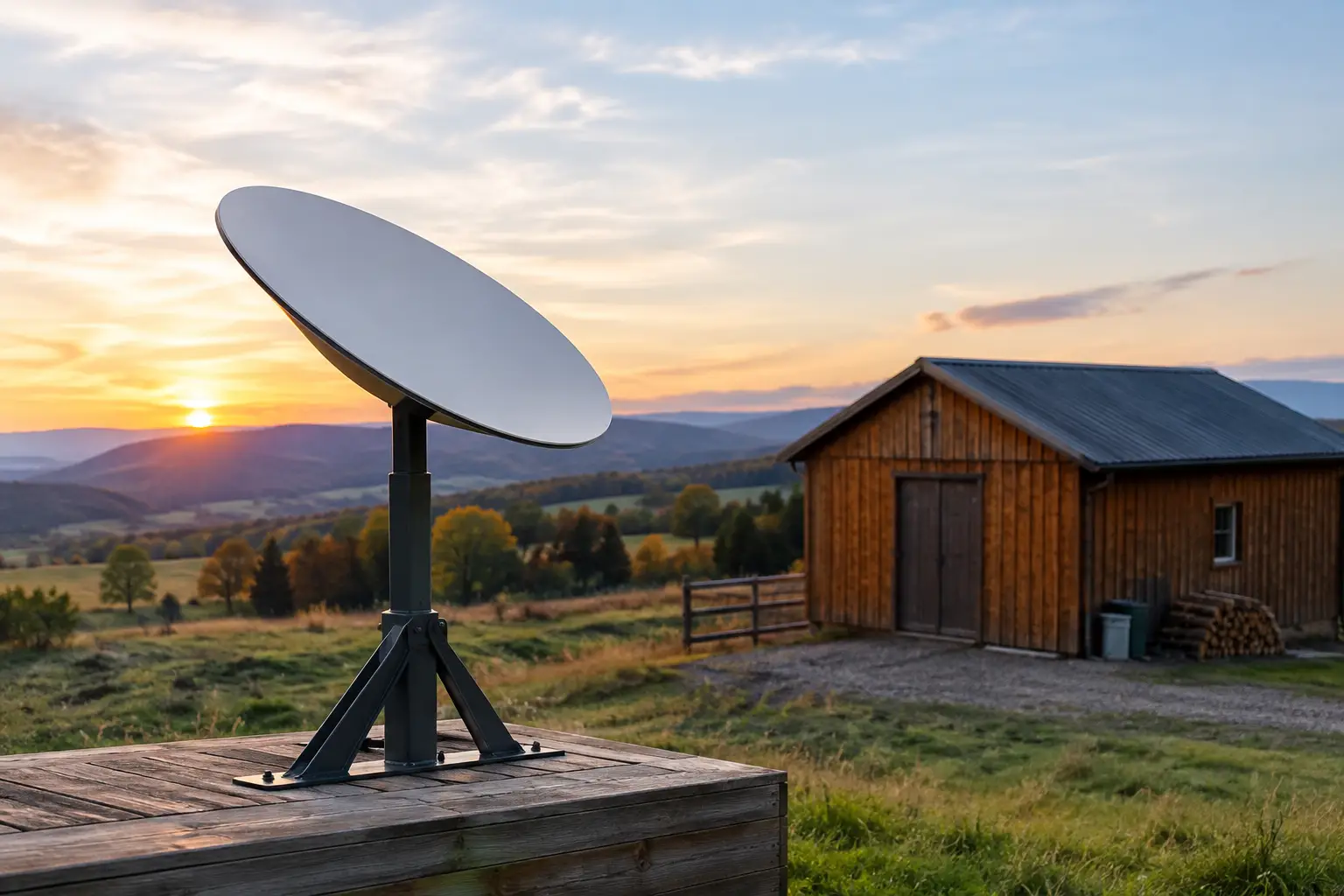
A Starlink dish may bring fast internet to a farmhouse that has struggled with fixed-line broadband for years, but the calving shed is still 300 metres away and the workshop is behind a line of mature trees. So, can Starlink cover outbuildings? Yes, but not by relying on the Starlink signal alone. The dish provides the internet connection at one location; a properly designed wired or wireless network carries it safely and reliably to the buildings that need it.
For farms, estates and rural businesses, that distinction matters. It is the difference between occasional Wi-Fi in a shed and a connection dependable enough for CCTV, livestock cameras, card machines, office equipment, smart controls and staff devices.
Can Starlink cover outbuildings directly?
Starlink communicates between its dish and satellites overhead. It does not transmit internet directly to every barn, stable, garage or workshop around the site. Once installed, the Starlink router creates a local network, and that network must be extended to each outbuilding.
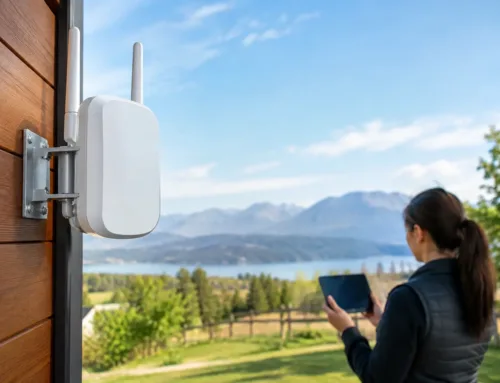
A short-distance building with clear open space between it and the main property may be able to use outdoor Wi-Fi equipment or a carefully positioned mesh access point. That can be acceptable for light use, such as checking messages or connecting a tablet.
For most working rural sites, however, standard domestic Wi-Fi is not the answer. Thick stone walls, steel cladding, grain stores, machinery, tree cover and distance all weaken the signal. A connection that seems acceptable on a quiet day may become frustrating when several cameras are recording or staff are trying to work from the same building.
The sensible approach is to treat Starlink as the broadband source, then build a network around the site according to distance, terrain, building use and future requirements.
The two reliable ways to extend Starlink
Wired connection between buildings
Where it is practical to run a cable, a wired link is normally the most stable option. Fibre is particularly well suited to longer runs between buildings because it can carry data over substantial distances and is not affected by electrical interference from machinery, motors or agricultural equipment.
Fibre also avoids creating a conductive path between buildings with separate electrical supplies, which is an important consideration on larger sites. It can be installed in suitable external ducting or as an armoured cable, with equipment at each end providing network and Wi-Fi connections locally.
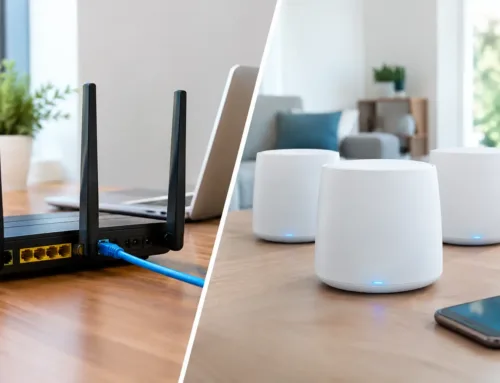
Copper Ethernet can be suitable for shorter runs, but it has a distance limit and needs careful protection outdoors. It is rarely the best choice for a long farmyard route simply because it is cheaper at the outset. Groundworks, routing, termination and protection need to be considered as part of the installation, not after the cable has been laid.
A wired connection is often the right choice for a renovated barn office, a workshop used every day, or a building where reliable CCTV footage is essential.
Point-to-point wireless links
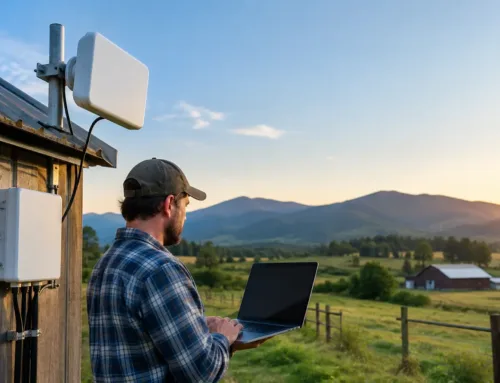
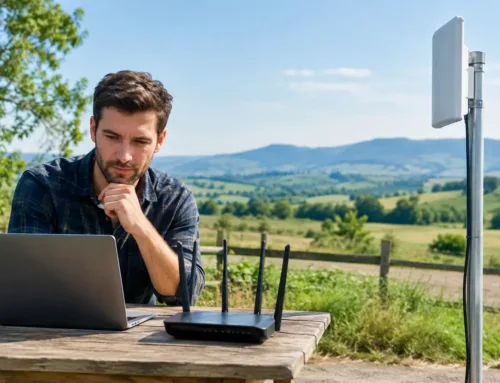
Where trenching is impractical, disruptive or expensive, a point-to-point wireless link can be an excellent solution. This uses a matched pair of professional outdoor radios: one mounted at the Starlink-connected building and one at the outbuilding. Together, they create a dedicated network bridge across the yard, field or driveway.
The key requirement is a clear line of sight. Trees, hedges, roofs, silos and the changing leaf cover of a summer canopy can all reduce performance. A wireless link may need mounting at eaves height, on a suitable pole or at another carefully chosen position to clear obstructions.
A well-designed wireless bridge can serve buildings hundreds of metres apart and, in the right conditions, much farther. It is commonly used to connect stables, grain stores, lambing sheds, holiday accommodation, gatehouses and remote camera locations without digging across yards or fields.
The equipment must be securely mounted, correctly aligned and protected from weather and electrical surges. This is not the same as placing a domestic Wi-Fi repeater in a window. Site survey work is what reveals whether wireless is the straightforward answer or whether fibre will provide better value over the life of the system.
Match the connection to what the building needs
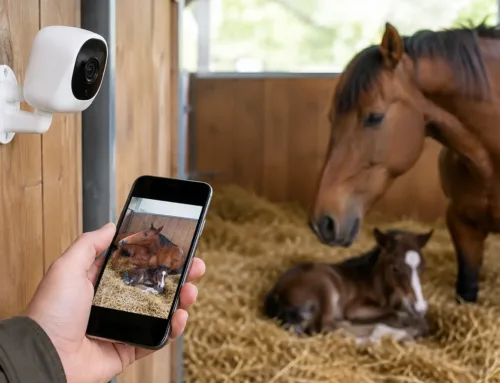
Not every outbuilding needs the same level of connectivity. A small garden office may only need good Wi-Fi for video calls and a printer. A machinery shed may need coverage for a couple of cameras and a smart alarm. A livestock building may require several high-definition cameras, remote viewing, alerts and a dependable connection during busy calving or lambing periods.
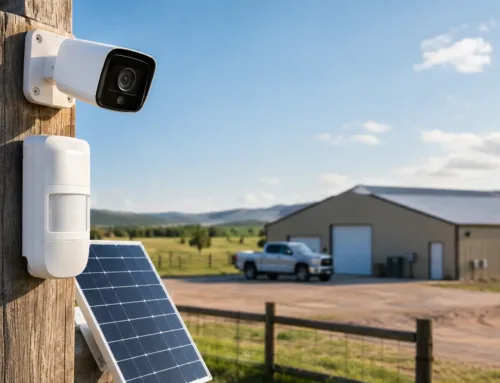
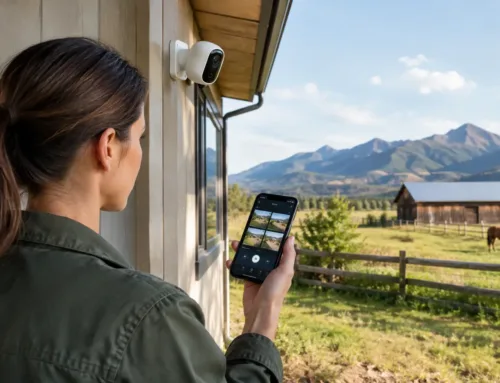
CCTV deserves particular attention. Cameras do not just need download speed – they send video back across the network, so upload capacity and local network design matter. Starlink can provide capable rural broadband, but the available performance can vary with network demand, weather and the installation environment. A camera system should be configured around the real connection available, including recording settings, remote viewing requirements and the number of users likely to access footage.
For critical monitoring, local recording at the camera recorder or network video recorder provides an additional safeguard. If the broadband connection is briefly interrupted, footage can still be retained on site and viewed when connectivity returns. For remote buildings, this is usually more sensible than depending entirely on cloud recording.
Do not overlook power, positioning and weather
The Starlink dish itself needs a broad, unobstructed view of the sky. A site may have a perfect network route to the workshop but a poor location for the dish because of trees, chimneys or a nearby hill. Dish placement should be assessed first, as moving it later can mean reworking cables, mounts and network equipment.
Each outbuilding also needs safe, stable power for its network equipment. That could include a wireless radio, network switch, Wi-Fi access point and cameras. In sheds exposed to dust, moisture or temperature changes, equipment should be housed appropriately rather than left on a bench beside a consumer router.
Mains power interruptions are another practical issue. A small uninterruptible power supply can keep core network equipment and a recorder running through short outages, but it will not replace a full backup power plan. Sites with frequent outages may need to consider a generator arrangement, battery backup or a secondary 4G or 5G connection for selected services.
Build one network, not several disconnected fixes
It is tempting to solve each problem separately: one mobile router in the shed, another broadband account for the cottage, a standalone camera kit at the gate. That can work in the short term, but it often leads to extra subscriptions, weak support arrangements and systems that do not communicate well with one another.
A better design uses Starlink as one broadband source and distributes the connection through a planned network. The main house, office, workshop and livestock buildings can then have appropriate wired points or Wi-Fi coverage, while cameras, alarms and business devices can be separated from guest or staff access where required.
This makes expansion easier. If a new shed is built or more cameras are needed, the network already has a sensible backbone rather than a collection of improvised repeaters.
What a site survey should establish
Before choosing fibre or wireless, a survey should establish the actual route between buildings, likely obstructions, available power, mounting options and the services needed at each point. It should also consider future changes, such as another camera at the entrance, an office move, electric gate controls or a new livestock unit.
On farms and estates, access routes matter too. A cable route that crosses a regularly used track may need different protection from one running along a hedge line. A wireless link that clears a roof today may be affected by planned construction or growing trees in future.
CUBTECH designs Starlink-backed rural networks around these site realities, combining connectivity with CCTV, alarms and long-range wireless where needed. The objective is not simply to get a signal into an outbuilding, but to provide a connection that supports how the property is actually used.
A dependable connection starts beyond the dish
Starlink can be an excellent answer for rural properties with poor broadband, and it can absolutely support outbuildings. The dish is only the starting point, though. Fibre or a properly installed wireless bridge turns that broadband connection into useful coverage across the site, giving remote buildings the connectivity they need without compromising security, reliability or room to grow.