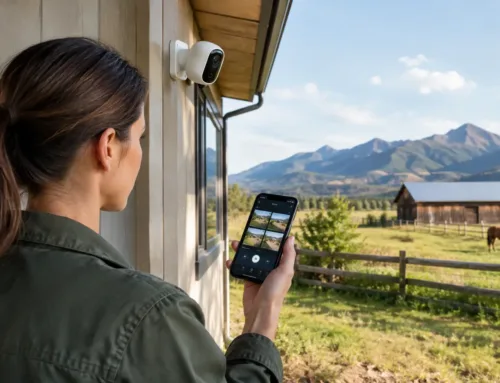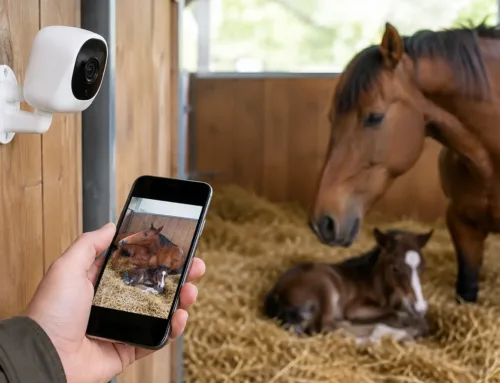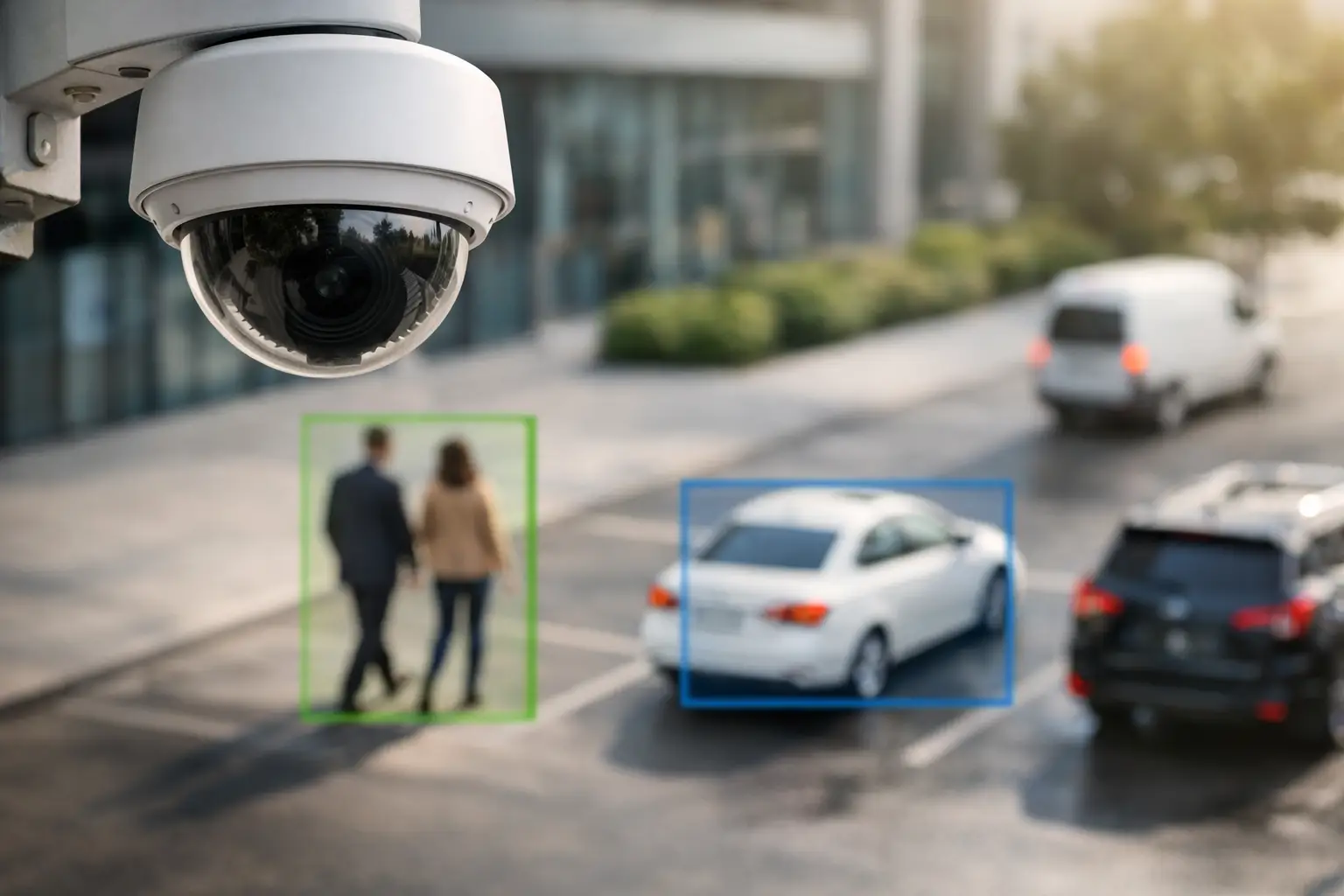
A camera notification at 2am is only useful if it tells you something worth acting on. For farms, estates and rural businesses, conventional motion alerts can become background noise: a sheep passes a shed, branches move in the wind, rain catches the infrared light, or a tractor returns late from the field. CCTV people and vehicle detection helps separate genuine activity from the everyday movement that comes with a working rural site.
Rather than alerting whenever pixels change in an image, an AI-enabled camera is configured to recognise the shape and movement patterns of people and vehicles. This makes CCTV a more practical management and security tool, particularly where buildings are spread out, access tracks are long and somebody cannot be expected to check every alert.
What CCTV people and vehicle detection does
People and vehicle detection is an analytical feature built into selected CCTV cameras and recorders. The system examines movement within the camera view and classifies it. When a person or vehicle enters a chosen area, it can send an alert, record a marked event or trigger another part of the security system.
The important distinction is that it is not simply a more sensitive motion detector. In fact, a well-configured system is usually less likely to bother you. It can ignore general movement while drawing attention to activity that may need a response.
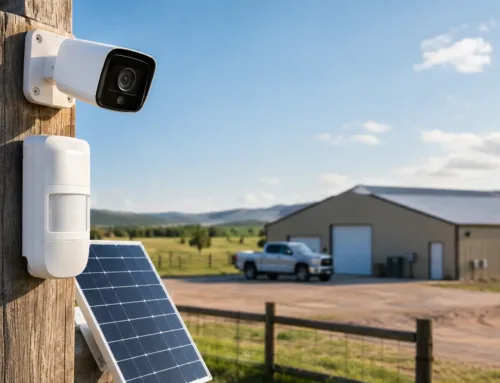
On a farm, that might mean receiving an alert when somebody walks through a machinery yard after hours, or when a vehicle enters a private access road. At a commercial unit, it could flag a van arriving at a rear gate outside delivery times. At home, it can distinguish a visitor approaching the door from the neighbour’s cat crossing the drive.
Recognition is not infallible. Camera angle, distance, darkness, weather and the size of the subject all affect accuracy. A person partly hidden by a gatepost may not be identified, while a quad bike may be classified differently depending on the camera and settings. The aim is useful filtering, not a guarantee that every event is interpreted perfectly.
Why it matters on rural and wide-area sites
Rural properties often have more ground to cover and more legitimate movement than an ordinary town-centre premises. There may be several barns, workshops, livestock buildings, fuel tanks, gateways, stores and staff access points, with activity beginning before daylight and finishing well after it.
A standard camera system can provide valuable evidence after an incident, but detection adds a chance to know about a problem while it is happening. That could mean checking a live view when a vehicle enters a yard, calling a keyholder, or passing relevant footage to the police promptly if there has been unauthorised access.
False alerts are not merely irritating. If notifications arrive constantly, people switch them off or stop looking at them. In that situation, the camera may still be recording, but it is no longer supporting a timely response. Filtering alerts for people and vehicles makes it more realistic to leave notifications enabled.
This is particularly helpful around:
- farmyards, machinery stores and fuel areas
- estate entrances, private tracks and remote outbuildings
- commercial compounds, loading areas and staff car parks
- rural homes with long drives, gates or detached garages
- temporary sites where equipment, materials or plant need monitoring
The right design will account for normal site activity. A delivery vehicle arriving during working hours may be expected; a vehicle entering a locked compound at midnight is not. Detection schedules and rules can reflect that difference.
Detection needs good camera placement
AI functions cannot correct a poor view. The most capable camera will struggle if it is mounted too high, pointed directly into low sun or expected to identify activity at the far end of a large field.
For people detection, the camera needs a clear, useful view of where somebody is likely to walk. Gates, doors, pathways, yard entrances and narrow access routes are often better locations than a camera trying to oversee every square metre from one high corner. A person who fills enough of the frame and crosses the scene at a sensible angle is easier for the system to classify.
Vehicle detection works well at entrances, driveways and tracks, where vehicles move through a defined area. On an open yard, it may be necessary to draw a detection zone that excludes a busy public road, neighbouring land or a gateway regularly used by staff. This prevents every passing car from generating an alert.
Night performance matters just as much. Infrared illumination can provide a usable black-and-white image, while additional lighting may improve colour and detail in critical areas. Yet too much reflected infrared from corrugated cladding, a close wall or heavy rain can reduce image quality. A site survey identifies these practical issues before equipment is selected and fitted.
Setting alerts around the way your site works
The most useful systems are set up around routines, not left on factory defaults. A farm may need separate rules for the main yard, an isolated implement shed and a livestock building. A business might want alerts for its rear compound overnight but not for the customer car park during opening hours.
Detection zones allow the installer to mark the parts of an image that matter. You might exclude a road beyond a boundary, the upper branches of a tree or a footpath outside the property. Some systems can also use line-crossing rules, such as alerting only when a person crosses into a yard rather than when they move around within it.
Scheduling adds another layer. For example, notifications can be limited to evenings, weekends and holiday closures, while recording remains active at all times. This avoids unnecessary prompts during normal trading or farm work, without losing footage if something later needs checking.
It is sensible to decide who should receive alerts and what they are expected to do. A single owner may be right for a rural home. On a larger operation, alerts might go to a manager and a designated keyholder. Keep the notification group small enough that responsibility is clear, and test the system after setup. An alert that reaches a phone late, or not at all, is a connectivity issue worth resolving rather than accepting.
Connectivity is part of the CCTV design
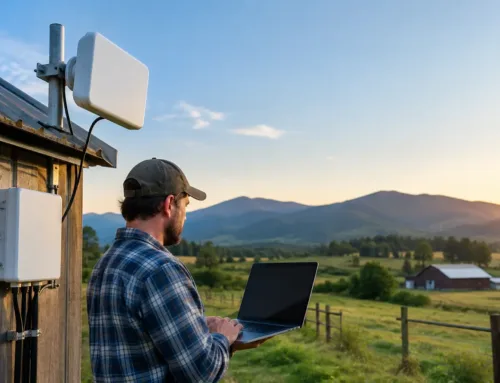
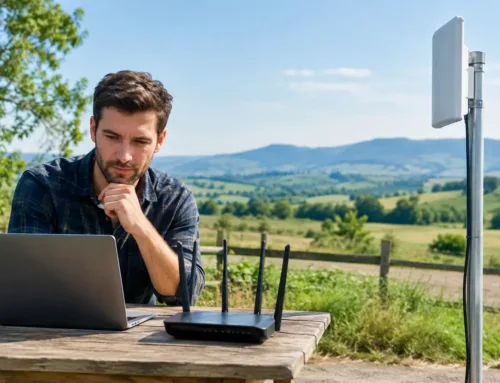
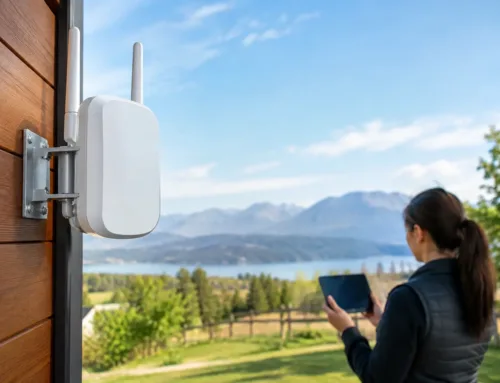
A camera at a remote barn is only as useful as the power and network connection behind it. Where cable routes are practical, wired network connections provide excellent reliability. For buildings separated by yards, roads or fields, a professionally installed wireless link can carry the camera connection between locations without digging long trenches.
Internet connectivity affects remote viewing and alerts, but it does not always prevent local recording. A properly designed system can keep recording to its recorder when the broadband drops, then restore remote access when the connection returns. That distinction is important for rural sites with inconsistent fixed-line services.
Where conventional broadband is weak, 4G, 5G or Starlink may provide a workable route for viewing cameras remotely and receiving notifications. The best option depends on mobile coverage, the position of buildings, expected data use and whether the connection will also support office systems, guest Wi-Fi or other services. It should be assessed as part of the whole installation, not added as an afterthought.
People detection is not a replacement for good security
CCTV detection is most effective when it supports wider site security. Cameras can deter opportunistic access, document what happened and alert the right person, but they do not physically stop somebody entering. Gates, locks, lighting, alarms and sensible storage arrangements still have their place.
For higher-risk areas, linking CCTV with an intruder alarm can strengthen the response. An alarm can provide an immediate audible warning or monitoring signal, while camera footage helps a keyholder assess what has triggered it. The precise setup depends on the risk, the site layout and whether the building is occupied or isolated overnight.
Privacy also needs consideration. Cameras should be aimed at your own property and operational areas wherever possible. If a view includes a public road, neighbouring land or staff areas, use privacy masking and appropriate signage where required. Recorded footage should be protected with strong user access controls, and retention periods should reflect the reason the system is in place.
Choosing the right system for the job
The right specification is rarely determined by the camera price alone. A modest number of correctly positioned cameras with properly configured detection can be more valuable than a larger system that produces unclear footage and constant alerts.
A survey should establish the key risks, likely routes of access, lighting conditions, distances between buildings, power availability and internet reliability. It should also cover what you want to achieve day to day: protecting machinery, monitoring an entrance, checking remote livestock buildings, supervising a compound or simply knowing when somebody has arrived at the gate.
CUBTECH designs systems around those site conditions, combining CCTV with the wired, wireless and rural connectivity needed to make it dependable in use. The fitting is only part of the job. Detection zones, alert rules, remote access and user handover are where a camera system becomes genuinely useful.
The best test is straightforward: when your phone alerts you, can you quickly see what has happened, decide whether it matters and act with confidence? If the answer is yes, the system is earning its place on the site.