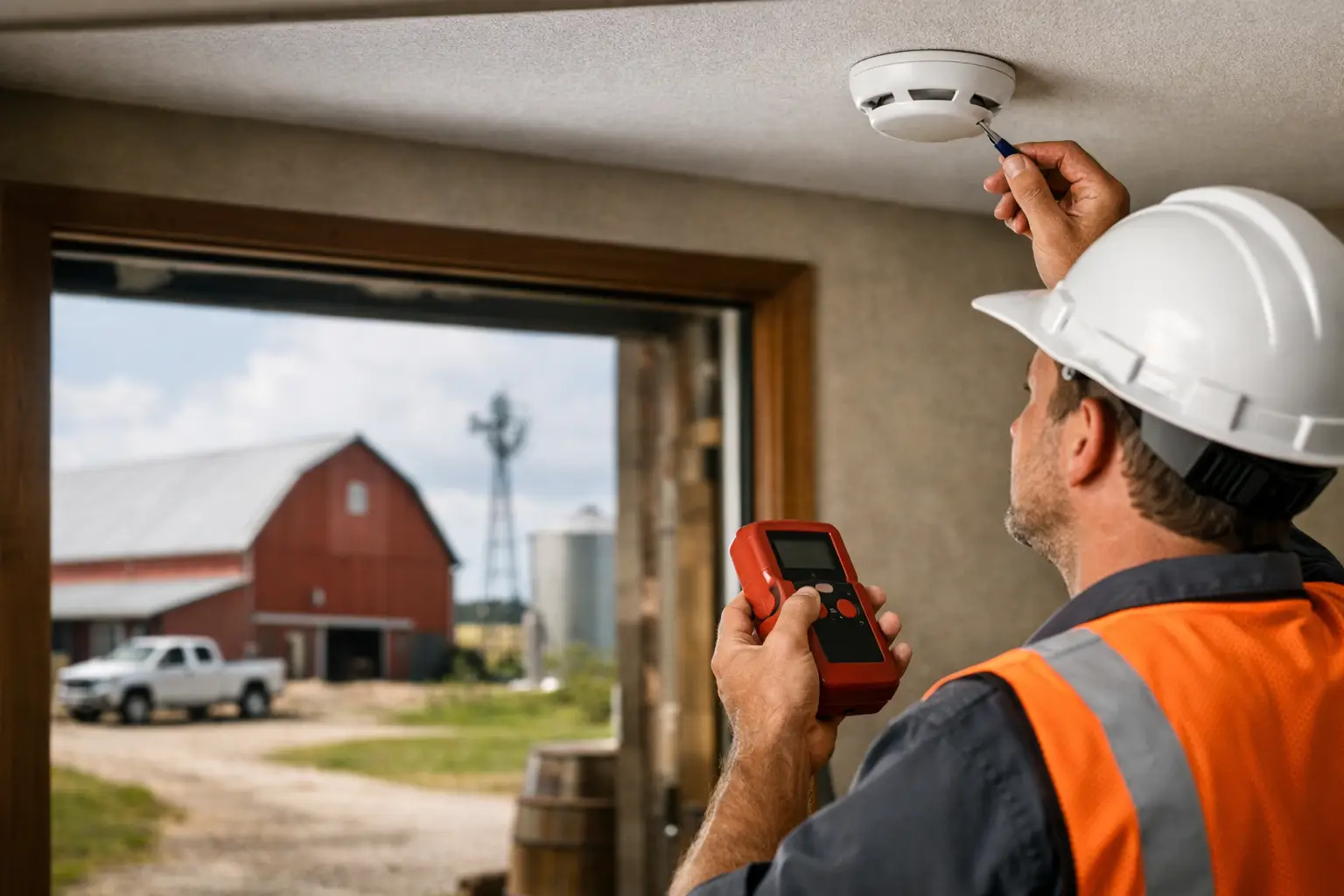
A fire alarm is only useful if it raises the warning when people need it most. For a farm workshop, holiday accommodation, village business, estate office or storage building, fire alarm testing is the practical routine that confirms the system is ready to do its job – not simply a box-ticking exercise.
Rural sites often make this more important, not less. Buildings can be spread out, occupied intermittently and used for changing purposes. A converted barn may contain offices today, a farm shop tomorrow and seasonal storage next winter. Add machinery, fuel, electrical equipment, dust, livestock areas or overnight guests, and small faults can have serious consequences if they go unnoticed.
Why fire alarm testing needs a planned routine
A fire alarm system is made up of more than detectors on the ceiling. It may include manual call points, sounders, visual alarm devices, control panels, batteries, signalling equipment and interfaces with doors, ventilation or other safety systems. A problem with any one part can affect the warning people receive.
Regular testing identifies straightforward issues early: a call point that has been damaged, a weak standby battery, a detector obstructed by dust, a sounder that cannot be heard in a new extension, or a panel showing a fault that nobody has acted on. It also familiarises staff with the alarm sound, the panel and the action expected when an alarm operates.
For most non-domestic premises in England, the responsible person has duties under fire safety legislation to take general fire precautions. The required arrangements should reflect the fire risk assessment and the building’s use. There is no useful one-size-fits-all approach for a small office, a busy farm shop, a workshop and a block of serviced accommodation. However, a documented testing and maintenance regime is a sensible part of managing fire safety in each case.
Domestic alarms are different. A private home is not managed in the same way as a workplace, but household smoke and heat alarms still need routine checks in line with the manufacturer’s instructions. If a house forms part of holiday accommodation or staff accommodation, take advice on the applicable requirements rather than assuming a domestic arrangement is enough.
A sensible weekly fire alarm testing process
For many commercial fire detection and fire alarm systems designed to British Standard BS 5839-1, the routine user test involves operating a different manual call point each week. This helps demonstrate that the panel receives the signal, warning devices operate and the system can be reset correctly. The result should be entered in the logbook.
Before starting, tell anyone who could be affected. That includes staff, tenants, visitors and, where relevant, a monitoring centre or alarm receiving centre. If the system sends a signal off site, failure to notify the right people can lead to an unnecessary response and avoidable cost.
Choose the next call point in the planned rotation and activate it using the correct test key. Check that the alarm sounds throughout the areas where people may be working or sleeping. In a large agricultural building, do not assume that an audible alarm near the panel can be heard over machinery, extraction equipment or across a yard. Where visual alarm devices are fitted, check these operate too.
Once the test is complete, reset the call point and panel in line with the site instructions. Check the panel returns to normal and investigate any fault, warning light or message that remains. Record the date, time, call point tested, result and any action required. If the alarm did not operate as expected, treat that as a fault requiring prompt attention rather than leaving it for the next service visit.
The exact arrangements should be set out for your system and site. A competent installer or maintainer can provide clear instructions for the person appointed to carry out the user test. That person does not need to be an alarm engineer, but they do need to understand the procedure, know who to contact and have the authority to report problems.
Testing is not the same as servicing
Weekly user checks are valuable, but they are not a substitute for planned maintenance by a competent fire alarm engineer. During a professional service visit, the engineer can inspect the installation more closely, test a suitable proportion of devices, review fault history, assess batteries and connections, and identify changes that may affect system performance.
For many systems, professional inspection and servicing is normally carried out at least every six months, although the appropriate interval depends on the system, its category, the environment, insurer expectations, manufacturer guidance and the outcome of the fire risk assessment. Dusty workshops, livestock buildings, commercial kitchens and buildings with frequent temperature changes may need closer attention than a clean, lightly used office.
Detectors are particularly affected by their environment. Dust, insects, steam, cooking vapours and airborne particles can cause false alarms or reduce performance. It is tempting to cover a troublesome detector, disconnect a sounder or silence a recurring fault. That creates a much bigger problem. The right answer is to have the cause assessed and, if necessary, alter the detector type, position or protection to suit the space.
Common rural-site issues to look for
Distance is a recurring challenge. An estate may have a main building, workshops, plant rooms, stores and staff facilities separated by yards or tracks. If people work alone or in outbuildings, the warning strategy needs to reflect where they actually are, not just where the original panel was installed.
Changes of use matter too. A former machinery store converted into a farm shop, office or holiday let may require a different level of detection, clearer escape routes and a review of alarm audibility. Likewise, a new mezzanine, partition wall, solar inverter, battery storage area or extension can affect the original fire strategy.
Poor connectivity can complicate remote signalling, but it should not be ignored. If an alarm system signals to a receiving centre or a keyholder, the path needs to be dependable and regularly checked. On remote properties, suitable wired, cellular, wireless or satellite-backed connectivity may form part of the wider solution, depending on the site survey and available coverage. The alarm system itself must remain capable of warning occupants locally even if an external communications path fails.
Power reliability is another consideration. Panels rely on mains power and standby batteries. Repeated outages, generator changeovers or electrical works can reveal faults that are not obvious during normal operation. Make sure panel faults are reported quickly, and do not leave a system in a disabled or isolated state after contractors have finished work.
Keep records that are useful, not merely compliant
A logbook gives you a running picture of the system’s condition. It should record weekly tests, faults, false alarms, service visits, alterations, periods when parts of the system were isolated and corrective work completed. This is useful evidence for fire safety management, but it is also practical information for the next engineer attending site.
False alarms deserve attention. They disrupt work, desensitise staff and can lead people to delay their response when a genuine alarm occurs. Record the time, location and likely cause. Patterns often emerge: a detector near a shower room, a loading door that brings in dust, a sensor exposed to cooking fumes, or a device affected by overnight temperature changes.
Alongside the alarm record, keep evacuation arrangements current. New starters, seasonal staff and contractors should know what the alarm sounds like, where to go and who is responsible for checking key areas if this is safe to do. A test of the alarm is not necessarily a full evacuation drill, but both have a place in a well-managed fire safety plan.
When to bring in a competent engineer
Call for professional support if the panel shows a persistent fault, alarms activate without an obvious reason, devices have been damaged, batteries need replacement, building works have changed the layout, or the system has not been serviced as scheduled. The same applies if you are unsure whether the existing alarm remains suitable for how the building is now used.
For larger farms, estates and business sites, it is helpful to work with one provider that understands the building layout, power supply, connectivity and wider security infrastructure. CUBTECH can survey business premises, install and commission fire alarm systems, and provide practical guidance on the testing and support arrangements that suit the site.
A reliable fire alarm arrangement starts with a routine that people can actually follow. Put a named person in charge of the checks, keep the logbook where it can be found, act on faults promptly and review the system whenever the building or its use changes. That gives everyone on site a better chance of receiving a clear warning when seconds matter.